
See What It's All About...
Welcome to the Poster Reception
Your experience has already begun!

Oct 9 | 5:00 PM - 6:00 PM
Traverse City, MI
As a “flipped” poster session, it’s important for attendees of the poster reception to familiarize themselves with the topics being presented before the reception begins.
The reception is a chance to dive into topics of interest, rather than hear “elevator pitches.” By visiting this page, you have already taken the first steps!
How to Prepare
Read the presentation description, listen to the presenters describe their work, and view the actual poster. Take notes and jot down thoughts to share with the presenter or questions you’d like to ask.
What to Expect
At the poster session, each poster display is designated
by the following:
-
tent card listing the poster title and presenter name(s)
-
tabletop display of the poster
-
QR Code for the digital poster gallery
-
the poster presenter
Why This Format
Use this time together to support your peers and learn from one another as we discuss a broad range of topics, share resources, and encourage future scholarly activities!
Presenters will be stationed throughout the space, ready to share their work and engage in conversation with you! Go at your own pace, guided by the work you have already done in the online gallery.
Digital Poster Gallery
ITLC-Lilly
Traverse City 2025
Posters are sorted A-Z

Adopting Competency-Based Nursing Education Through Course Redesign in Clinical Pharmacology


Presented by:
Cheryl VerStrate, Grand Valley State University
Employing alternative grading and active learning strategies can transform a learning space into an environment that encourages knowledge application and develops critical thinking skills.

Articulating an Authentic Teaching Philosophy Statement in the Age of AI

Presented by:
Kelly Ford, University of Georgia
Developing compelling teaching statements requires deep self-reflection. Solution-focused frameworks aid in articulating core pedagogical values, while intentional prompting of GAI supports organization and audience-aligned refinement.
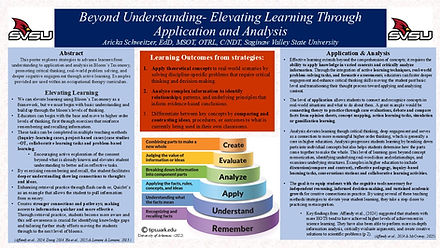
Beyond Understanding: Elevating Learning Through Application and Analysis
Presented by:
Aricka Schweitzer, Saginaw Valley State University
This poster explores strategies to advance learners from understanding to application and analysis in Bloom’s Taxonomy, promoting critical thinking, real-world problem solving, and deeper cognitive engagement through active learning. Examples provided are used within an occupational therapy curriculum.

Building Communication and Professional Identity Through Active Learning Mock Interviews

Presented by:
Crystal Smith, Louisiana State University of Alexandria
An active learning mock interview day engaged nursing students and community partners to advance communication, professionalism, and career readiness through authentic, high-impact experiences.


Human-Centered Teaching With AI for UDL, Engagement, and Efficiency
Presented by:
Sally Barton-Arwood, Belmont University
AI can support UDL-aligned teaching by enhancing accessibility, engagement, and literacy while modeling reflection, human judgment, and responsible use for both students and faculty.


Leveraging AI To Generate High-Quality Coding Practice Questions Aligned With Learning Objectives

Presented by:
Xiaojing Duan, University of Notre Dame
This poster demonstrates how to leverage AI to create high-quality coding practice questions aligned with learning objectives, reducing instructor workload while improving student learning.

Partnering With a Community Service Agency: A Unique Pedagogy Utilizing Service-Learning for Students To Meet Course and Program Outcomes
Presented by:
Christina Snider, University of Michigan-Flint
Incorporating service learning as a pedagogy gives students a unique opportunity to meet course and program outcomes.


Turn Toward the Light: Coaching for Connection in the College Classroom
Presented by:
Angela D. Nagel, Western Kentucky University
Resiliency coaching practices help build emotionally safe learning environments where students feel seen, supported, and empowered to persist, even through academic and personal challenges.


Beyond the Degree: An Interprofessional Education Student Micro Credential
Presented by:
Denise Ludwig, Grand Valley State University
The Interprofessional Education Student Badge is a micro credential with a focus on the duality of role development and demonstrated use of IPEC interprofessional competencies.

Chemistry Graduate Teaching Assistants’ Noticing for Equity

Presented by:
Dani Losinski, University of Michigan
STEM Graduate Teaching Assistants have powerful opportunities to construct equitable learning, but experience constraints. Findings highlight opportunities to support equitable teaching through community building.

Escape the Rubric Rut: Creative Strategies for Teaching Assessment Literacy
Presented by:
Angela D. Nagel, Western Kentucky University
Engaging strategies like exemplars, escape rooms, and AI feedback help teacher candidates build assessment fluency and confidence in designing, analyzing, and applying effective feedback.

Increasing Student Involvement in Health Literacy Through Bricks by ScholarRX

Presented by:
Kerry A. Pickin Paumi, Centre College
By writing and publishing educational materials for enhanced health literacy using the ScholarRX BrickExchange online teaching platform students engaged in local community public health issues.

K–12 Teachers’ Enactments of Professional Agency During Collaborative Design
Presented by:
Megan Gibas, University of Michigan
We engaged in collaborative design to co-create place-based lessons in a Northern Alaskan community. Findings suggest flexible collaborations support professional agency and transformative teaching.


Planning an Interprofessional Simulation: Overcoming the Excuses and Moving Forward

Presented by:
Jennifer Essig, Indiana University South Bend
Stop letting time and energy prevent you from creating the collaborative learning experiences you dream about for your students. Simulations can start small and grow.

Making a Difference Together
OUR PARTNERS


OUR SPONSORS
%20-%20640x200.jpg)

